 |
| Keeping the parking spot with some creative means. two weeks ago, on Haroun street in Dokki |
Showing posts with label photography. Show all posts
Showing posts with label photography. Show all posts
Friday, July 12, 2013
Photo: Chair with a cool penchant


Monday, July 1, 2013
Photo: Maadi Buildings
 |
| I forgot the name of this street, But I was impressed how everything is so straight. |
Tuesday, June 25, 2013

Monday, April 22, 2013
Photo: Going Away, Party
Sometime in February. Lots of Ballons. Good time.
 |
| Kikin' it back with stylin' boots. |
Saturday, April 20, 2013
Photo: Buddha Bar Cairo
Buddha bar is in the Sofitel Gezira. It's usually empty. Not sure why. But it certainly has amazing decor
scroll down a bit for the photo (click on it to fit to screen).
and a great view on the nile
keep on scrolling...
 |
| Was hanging out with VJ on his last night, took this picture. I'm always awed by giant statues of Buddha. Especially in Egypt. |
Thursday, April 18, 2013
Photo Essay: Azba Weekend
One weekend in February,
A friend invited me to her family's old villa in the Egyptian delta.
It was about two hours north of Cairo.
We had lunch, walked around the adjacent village, and generally chilled.
 |
| The Dinning Room. Ceiling was falling down, but food was delicious. |
 |
| Fiteer, cheese, honey, tea... all so good. |
 |
| A bedroom, with a gorgeous glass chandelier |
 |
| Taking photos of old stuff. This villa was made in 1924 by an Italian architect. Egypt used to be so classy. |
 |
| View from the roof of the villa. Since the revolution, new informal houses (with ultra conservative inhabitants) have sprung up on Laura's mom's land without her permission. |
 |
| Walking in the villa's surrounding fields. The fields still mostly belong to the Azba (villa) owners. |
 |
| In the village: Old traditional mud brick homes, replaced by cement. Above: somebody likes MIA. |
 |
| Kids with cool poses (notice their feet/legs). One of them (second from the right) was terrified for some reason. Most of them had never seen foreigners before. Adults are in the background. |
 |
| The village Shaykh, trying to calm them down. |
 |
| Laura, shooting away, while digesting our lunch under the shady breeze-filled patio. |
 |
| L's Mom and M were looking through the farm's meticulous old records. Stuff dated back to the 30's. Prices have since super-inflated. We even found an entry bookkeeping the purchase of a "Coca-Cola". |
 |
| I liked the sun/shadows on this part of the patio. |
 |
| Path leading through the garden |
 |
| Irrigation trenches for the garden. |
This is a pretty bad representation of what we saw. I only found inspiration to take photos towards the end of the day. I wish I had taken photos of the family portraits, Laura's mom's village community center-in-the-making, more of the house, and more of our ride there and back.
For more pictures of Egyptian rural scenes, click here and here.
Wednesday, April 10, 2013
Photo Essay: The Demise of Cotton’s Influence on Egyptian Culture
All photos and text by Ahmed Safyeldin (twitter: @ElKharouf)
This
is the second installment in a series of photo essays about the harvest of
traditionally important crops in Egypt, their current state, and the farmers
that tend their fields. These articles are an attempt to forge a new bond with
my ancestral village of Ahnasya Elkhadra in Beni Suef that my grandfather
abandoned fifty years ago to settle in Cairo. The articles also give me the
excuse to travel to my village and examine the situation on the ground.


The cotton
shrub is native to tropical and subtropical regions of the Americas, Africa,
and Asia. The Cotton plant was independently domesticated in India and Central
America 7,000 years ago, and woven into textiles for clothing and fishing nets.
Egypt’s cotton production began in earnest in the 1860s as a result of the
American Civil War disrupting Europe’s supply of raw cotton. The Europeans
invested heavily in Egypt, which resulted in a booming economy, and encouraged
Khedive Ismail (the Ottoman ruler of Egypt) to borrow heavily from British
creditors. After the American Civil War, the Europeans abandoned Egypt’s cotton
for the cheaper American variety. This resulted in a financial crisis that
forced Egypt to declare bankruptcy in 1873, and the direct intervention of
foreign powers in Egypt’s internal affairs, thereafter.
 |
| Add caption |
I began a
one-day trip to my
father’s cotton fields in Ahnasya Elkhadra with the typical train ride to Upper
Egypt from the Giza railroad station.
The train station’s Neo-Pharaonic architecture evokes
the images of the ancient Egyptian temples of Luxor and Aswan, and reminds the
passengers of their financial and ancestral ties to Upper Egypt. Jostling at the carriage door gave way
to a foyer with old red buttons on an open electrical board, and a luggage
compartment used as a bedroom by the porters. This led to a dimly lit
passengers’ section flooded by a yellowish sickly sleep-inducing color. I
inherited my preference for the train as the mode of transportation to and from
Beni Suef from my father who prefers its reliability. The uneventful train ride
brings back memories and anxieties of the trips my father and I took to Beni
Suef and the occasional adventures that entailed. The first pyramid I went
inside was on one of our rare return trips by car, my father stopped at the
Meydoum Pyramid (the symbol of the governorate of Beni Suef) and paid off the
policeman to take us inside. The
ride also evokes the anxieties I have towards my relatives in Ahnasya Elkhadra
who I could never relate to due to our differences in backgrounds and cultures.
For example, my relatives always ask me to find a job for an acquaintance of
theirs in my uncle’s company which embarrasses me into promising that I will,
but never deliver.
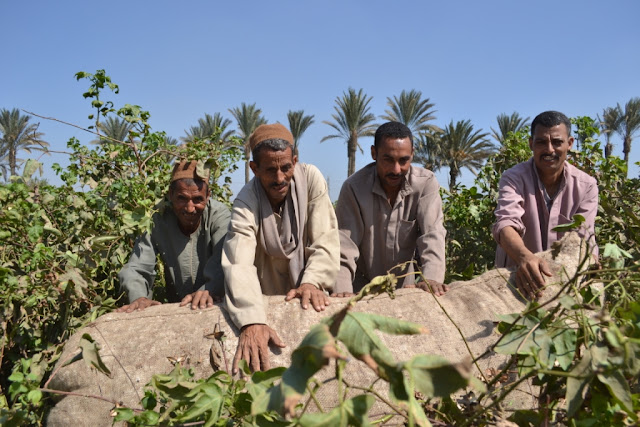

I
reached Beni Suef at 7:30 am and Hajj Ali Bakri, my father’s cousin, was
waiting for me on the platform to take me to Ahnasya Elkhadra. Half an hour
later, I was in the middle of my father’s cotton field outside our village
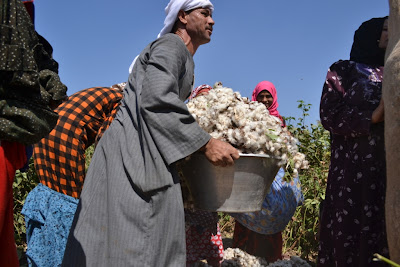
taking photographs of the workers harvesting the crop since dawn prayers. The Egyptian farmer traditionally
harvests cotton in the early morning to take advantage of the dew it which
makes the bales heavier and so commands a higher price at the scale. My father
has a sharecropping agreement with two farmers to grow crops on this plot of
land in return for half the revenue.
I commented to Hajj Ali on the height and size of the cotton bushes this
year. He replied that unusually intense heat waves late in the season result in
growth spurts that produce spoilt cotton pods. Therefore, only the lower half of the plant was harvestable.
Hajj Ali also complained about the new payment system which allows speculators
to control prices and keep them secret until after the harvest. Under the old
system which was installed by the Egyptian government after the 1952
Revolution, the ministry of agriculture fixed the prices according to the
international commodities market months in advance and was the sole buyer of cotton
in Egypt. Then in the 1990s Egypt started borrowing from the World Bank under
the stipulation to partially deregulate the agricultural sector causing the
government to abandon its role as the sole dealer of Egyptian cotton.


One of the
groups harvesting cotton was a band of about fifteen teenage girls wearing the
niqab. After working, on their way back home, they removed their niqabs. I was
surprised at their nonchalant attitude towards the niqab, especially because it
is worn by religiously conservative women. I asked an old farmer about the
girls’ behavior and he replied with a laugh: the girls wear a niqab during work
to protect their fair skin from the sun and attract suitors because they are at
the proper age to get married. By late morning the farmers rolled the huge
cotton bales out from the field, and on to donkey carts to store them in Hajj
Ali’s warehouse, adjacent to his home.


Egypt’s relationship with cotton has
been fundamentally altered. There are several reasons for this outcome. First,
the Egyptian farmer can no longer grow cotton every year because of its
detrimental effect on the soil; before the High Dam was built this was possible
because the flood replenished the soil with the nutrients consumed by the preceding
year’s crop. Second, the quality of Egyptian cotton decreased because after the
1952 Revolution, the government fixed the price, regardless of the quality;
therefore there was little incentive to grow quality cotton. Third, the
domestic demand for cotton has decreased because of the privatization of
Egypt’s textile industry and strong competition from cheaper textiles from
China. Cotton’s fall in commercial value was accompanied by an erosion of the
cultural trappings that surrounded it. I asked around on my trip if anybody
remembered the songs farmers used to sing during the cotton harvest; I was met
with puzzled looks. In addition, farmers used to wait until the harvest to have
weddings and make financial transactions because of the cash that cotton brought
in around this time of year. All of these factors played a role in the demise
of cotton’s cultural and commercial value to Egyptians.
In
conclusion, my trip to Ahnasya Elkhadra introduced me to the challenges facing
Egyptian cotton. Poor government policies compounded with the mounting financial
challenges of the Egyptian farmer led to this situation. Unless both
parties start working together to combine their efforts to raise the quality
and cultivation standards of this cash crop, Egypt will lose one of its main
resources of agricultural income.






Subscribe to:
Posts (Atom)